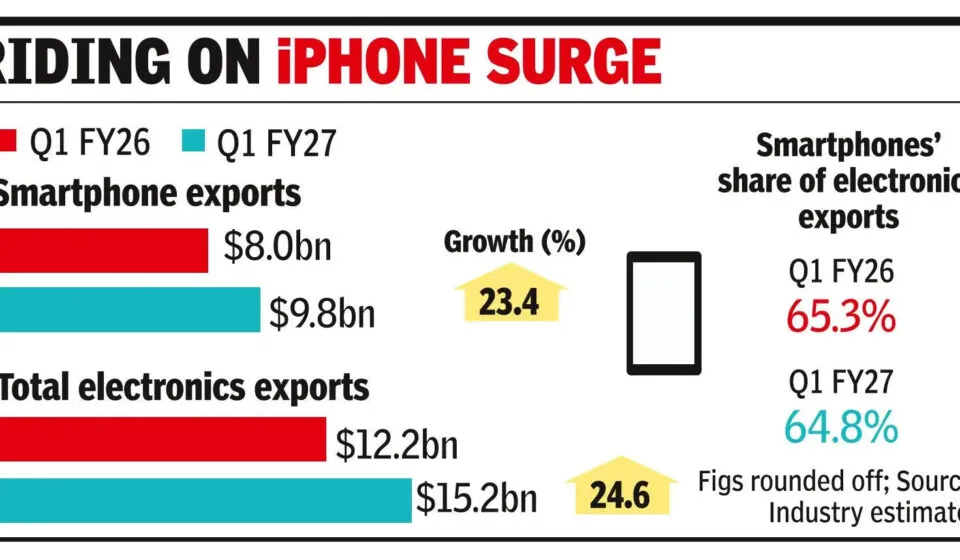

India’s Smartphone Export Boom: Q1 Sees Remarkable 23% Growth to $9.8 Billion
India’s electronics manufacturing sector has achieved a significant milestone, reporting a robust 23% surge in smartphone exports during the first quarter of the current fiscal year. This impressive growth has propelled the nation’s smartphone export value to an estimated $9.8 billion, underscoring India’s rapidly expanding footprint in the global electronics supply chain. The figures highlight the accelerating momentum of the ‘Make in India’ initiative and the effectiveness of government policies designed to foster domestic manufacturing and attract international investment.
This substantial increase signifies more than just a rise in numbers; it represents a strategic shift in global manufacturing dynamics and a testament to India’s burgeoning capabilities as a hub for high-tech production. The consistent upward trajectory in smartphone exports positions India as a crucial player, challenging established manufacturing giants and creating new economic opportunities domestically.
The ‘Make in India’ Vision Takes Flight
The journey towards becoming a global manufacturing powerhouse for smartphones has been meticulously planned and executed under the Indian government’s flagship ‘Make in India’ program. Launched with the ambition to transform India into a global design and manufacturing hub, this initiative has provided a conducive environment for both domestic and international companies to set up and scale their production facilities within the country. The focus has been on reducing reliance on imports, boosting local value addition, and creating employment opportunities across the manufacturing ecosystem.
A cornerstone of this strategy has been the Production Linked Incentive (PLI) scheme for large-scale electronics manufacturing, particularly targeting mobile phones. The PLI scheme offers financial incentives to companies based on their incremental sales from products manufactured in India. This policy has proven instrumental in attracting significant investments from global electronics giants and their contract manufacturers, thereby boosting local production capacity and export potential. The $9.8 billion export figure for Q1 is a direct reflection of the success of these policy interventions.
Key Drivers Behind the Export Surge
Several factors have converged to fuel India’s remarkable smartphone export growth, demonstrating a multifaceted approach to industrial development:
- Global Supply Chain Diversification: Geopolitical shifts and the desire for resilience in global supply chains have prompted major technology companies to diversify their manufacturing bases beyond traditional hubs. India has emerged as a preferred alternative due to its large domestic market, skilled workforce, and supportive government policies.
- Major OEM Investment: Leading global smartphone brands, most notably Apple and Samsung, have significantly ramped up their production in India. Apple, through its contract manufacturers like Foxconn, Wistron, and Pegatron, has expanded its iPhone manufacturing capabilities, turning India into a critical hub for global iPhone supply. Similarly, Samsung has long maintained a robust manufacturing presence, contributing substantially to both domestic sales and exports.
- Government Incentives: As mentioned, the PLI scheme has played a pivotal role. By offering attractive incentives, the government has encouraged manufacturers to invest in advanced production lines, increase output, and enhance competitiveness on the international stage.
- Infrastructure Development: Continuous improvements in logistics, power supply, and industrial park development have created a more efficient and attractive operational environment for manufacturers.
- Skilled Workforce Availability: India’s vast pool of engineering talent and a growing semi-skilled labor force provide a sustainable human resource base for the labor-intensive electronics manufacturing sector.
The synergy of these drivers has created a virtuous cycle, attracting further investment and fostering an ecosystem conducive to sustained growth in electronics exports.
Economic Impact and Future Outlook
The impressive growth in smartphone exports carries profound economic implications for India. Firstly, it significantly contributes to the nation’s foreign exchange earnings, helping to strengthen the balance of payments. Secondly, it acts as a powerful engine for job creation, both directly within manufacturing units and indirectly across the ancillary industries, logistics, and services sectors. This job creation is crucial for a young, aspiring workforce.
Moreover, the increased manufacturing activity stimulates foreign direct investment (FDI) into the country, bringing in capital, technology, and global best practices. This transfer of knowledge and technology is vital for enhancing India’s overall industrial capabilities and moving up the value chain in electronics manufacturing.
Looking ahead, while the prospects appear bright, India must continue to address potential challenges to sustain this momentum. These include:
- Deepening the Component Ecosystem: Reducing reliance on imported components by fostering local manufacturing of critical parts and sub-assemblies.
- Research and Development: Investing more in R&D to move beyond contract manufacturing towards original design manufacturing (ODM) and original brand manufacturing (OBM).
- Skilling and Training: Continuously upgrading the skills of the workforce to meet the demands of evolving technologies and automation.
- Global Economic Headwinds: Navigating potential fluctuations in global demand and international trade policies.
Despite these challenges, India’s trajectory in smartphone exports signals a promising future. The nation is steadily carving out its niche as a reliable and competitive manufacturing destination, poised to become an indispensable part of the global technology landscape.
India’s Growing Stature in Global Electronics
The remarkable 23% rise in smartphone exports to nearly $10 billion in the first quarter is not an isolated event but rather a continuation of a positive trend observed over recent years. India has been consistently climbing the ranks in global electronics manufacturing, moving from primarily being a consumer market to an increasingly important production hub. This growth contrasts sharply with the earlier scenario where India was largely dependent on imports for its electronic goods, including smartphones.
This performance underscores India’s strategic importance for multinational corporations seeking to de-risk their supply chains and tap into new growth markets. The country’s ability to scale production rapidly while maintaining quality standards has made it an attractive proposition, directly impacting its global standing as a manufacturing destination. The aim is not just to produce for India, but to produce for the world, and the latest export figures are a clear indication of progress towards achieving this ambitious goal.
Conclusion
India’s smartphone export sector has demonstrated extraordinary vitality, with a 23% increase in the first quarter pushing total exports to an impressive $9.8 billion. This surge is a powerful validation of the government’s ‘Make in India’ initiative and the Production Linked Incentive scheme, which have successfully attracted global manufacturing giants and fostered a robust domestic electronics ecosystem. As India continues to leverage its demographic dividend, strategic policies, and improving infrastructure, it is solidifying its position as a critical global manufacturing hub. The sustained growth in smartphone exports is not just an economic triumph but a strategic leap forward, signaling India’s rising prominence on the international stage and its potential to become a leader in high-tech manufacturing.