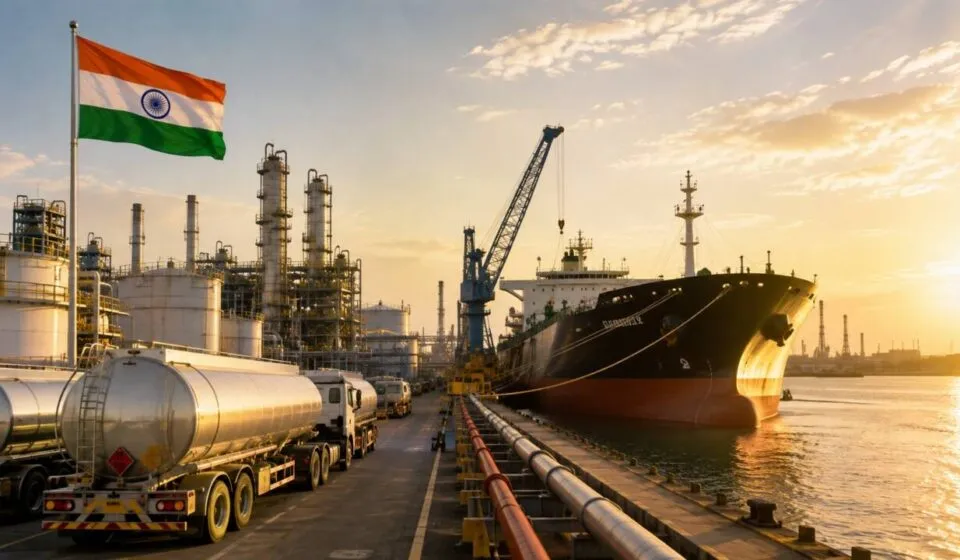
India’s Refined Fuel Exports Surge to One-Year High Amidst Robust Margins and Global Shifts

India has cemented its position as a pivotal player in the global energy landscape, with its refined fuel exports reaching a significant one-year high in July. Data from the analytics firm Kpler reveals that the nation exported an impressive 1.53 million barrels per day (bpd) of refined fuels during the month. This substantial volume marks an approximately 27% increase compared to the average monthly exports recorded over the preceding 12 months, underscoring a dynamic shift in international energy trade patterns driven by a combination of robust refining margins and evolving geopolitical factors, notably the impact of Russia’s diesel export restrictions.
The surge in Indian fuel exports highlights the country’s strategic importance as a major refining hub, capable of processing diverse crude oil grades and supplying a wide array of refined products to global markets. This upward trend is not merely a statistical anomaly but a reflection of calculated economic strategies and timely responses to international energy demands.
The Ascent of Indian Fuel Exports: A Detailed Analysis
The 1.53 million bpd figure for July is a testament to the operational efficiency and market responsiveness of Indian refiners. This considerable jump in export volumes signifies India’s increasing capacity to meet international demand, particularly for products like diesel, gasoline, and jet fuel. The 27% year-on-year growth underscores a sustained momentum that positions India as a crucial supplier in a volatile global energy market.
This performance is particularly noteworthy given the complexities of global energy trade, which has been grappling with supply chain disruptions, geopolitical tensions, and fluctuating demand patterns. India’s ability to not only maintain but significantly boost its export volumes reflects a competitive advantage derived from several converging factors.
Driving Forces: The Role of Robust Refining Margins
One of the primary catalysts behind India’s export boom is the prevailing environment of robust refining margins, often referred to as ‘crack spreads’. These margins represent the profit refiners make from converting crude oil into refined products. In recent months, global refining margins have remained elevated due to a combination of factors:
- Global Demand Recovery: Post-pandemic economic resurgence in various regions has led to increased demand for transportation fuels and industrial feedstock.
- Limited Global Refining Capacity: Years of underinvestment in new refining capacity in some parts of the world, coupled with refinery closures, have tightened the supply side.
- Strategic Crude Sourcing: Indian refiners have been adept at sourcing discounted crude oil, particularly from Russia amidst Western sanctions. This access to cheaper feedstock significantly lowers their input costs, thereby widening their profit margins on refined products.
By leveraging these favorable market conditions, Indian refineries have been able to operate at high utilization rates, maximizing output and profitability. The ability to acquire crude at advantageous prices and convert it into high-value products for export markets has been a key differentiator.
Geopolitical Tailwinds: The Impact of Russia’s Diesel Export Ban
Another significant factor contributing to India’s export surge is the evolving geopolitical landscape, specifically Russia’s restrictions on diesel exports. As a major global supplier of refined products, particularly to Europe, Russia’s decision to curb its diesel exports created a vacuum in the international market. This situation presented a substantial opportunity for other large refining nations, and India was perfectly positioned to fill this void.
India’s role in this scenario is often described as a ‘processing hub.’ The country imports vast quantities of crude oil, refines it, and then exports the finished products to markets that might otherwise have relied on Russian supplies. This dynamic has been particularly evident in Europe, where energy security concerns have driven a search for alternative suppliers of diesel and other middle distillates.
The shift in trade routes highlights the interconnectedness of global energy markets and how geopolitical decisions can rapidly reshape supply chains, benefiting countries with significant refining capabilities and flexible sourcing strategies.
India’s Refining Prowess and Strategic Position in the Global Energy Market
India possesses one of the largest and most sophisticated refining capacities in the world. Major players like Reliance Industries, Indian Oil Corporation, Bharat Petroleum Corporation Limited (BPCL), and Hindustan Petroleum Corporation Limited (HPCL) operate state-of-the-art facilities equipped to process a wide range of crude oil types, including heavier and more sour grades. Investments in upgrading these refineries have enhanced their complexity and ability to produce higher yields of valuable products.
Key aspects of India’s strategic advantage include:
- Scale and Modernity: Indian refineries are among the largest globally, benefiting from economies of scale and advanced technological infrastructure.
- Diversified Crude Basket: The country’s energy policy emphasizes diversifying crude oil sources, reducing reliance on any single region. This strategy proved highly beneficial when discounted Russian crude became available.
- Geographic Location: Situated strategically along major shipping routes, India has excellent access to both crude oil suppliers in the Middle East and Africa, and key demand centers in Asia, Europe, and Africa.
This robust infrastructure and strategic approach have enabled India to emerge as a reliable and significant exporter of refined fuels, capable of responding swiftly to global market dynamics.
Broader Implications for Global Energy Security and Trade
India’s increasing prominence in refined fuel exports carries significant implications for global energy security and trade patterns. For importing nations, particularly those in Europe, India represents an important alternative source, contributing to supply diversification and reducing dependence on traditional suppliers.
For India itself, the strong export performance not Pre not only boosts foreign exchange earnings but also reinforces its geopolitical standing as a crucial energy partner. The ability to convert raw crude into value-added products and export them globally strengthens the country’s energy independence and economic resilience.
However, the global energy market remains subject to volatility. Future trends will depend on a confluence of factors, including:
- Crude Oil Price Fluctuations: While discounted crude has been a boon, sustained high crude prices or changes in discounts could impact refining margins.
- Evolving Geopolitical Sanctions: Any shifts in international sanctions regimes or trade policies could alter supply dynamics.
- Domestic Demand Growth: India’s rapidly growing economy will also see increasing domestic demand for refined fuels, which refiners must balance with export opportunities.
- Energy Transition: The long-term global push towards renewable energy and electric vehicles will gradually reshape demand for traditional fossil fuels, necessitating strategic adjustments by refiners.
Despite these potential challenges, India’s current trajectory suggests a continued strong presence in the global refined fuels market for the foreseeable future, adapting to and influencing international energy dynamics.
Conclusion
The remarkable surge in India’s refined fuel exports to a one-year high in July underscores the nation’s growing influence in the international energy arena. Driven by highly profitable refining margins and strategically capitalizing on shifts in global supply chains, particularly in the wake of Russia’s diesel export limitations, Indian refiners have demonstrated exceptional agility and capacity. This performance not only bolsters India’s economic indicators but also solidifies its role as an indispensable and reliable supplier in the complex tapestry of global energy trade, marking a pivotal moment in its journey towards greater energy leadership.